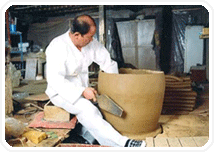
Lye used for traditional earthenware Onggi means ashes of burnt wood mixed with loess which is fermented for more than 2 months, diluted in water to collect sediment and then, fermented again for 3 months making traditional glaze with no harm to human body.Traditional Yesan Earthenware Onggi is made by Hwang Choong-Gil, only meister in Korea (No.98-23),
his sons and daughters in law, which was designated as Traditional culture family
(Chungnam certification No.26). ..
As meister Hwang Choong-Gil of Yesan grew up watching his grandfather and father making earthenware Onggi with clay shaped sincerely, he thought it is his mission to succeed to the family business of ancestors to continue tradition and dedicated his 40 years to only making traditional earthenware Onggi.
He says he feels it fruitful to got to making earthenware Onggi loved by customers with his so long struggle with clay not in vain. |
Earthenware Onggi, closest to nature, is a vessel made by coating glaze of mixture of pine ashes, bean chaff ashes and ingredient clay on loess and baking it. As it is made of large particles and lye, it has good ventilation and purifying effect. Yesan Onggi is baked in the heat of 1,250℃after mixing pine branchashes and lye with good ingredient clay, causing it to ferment and coating natural lye made of sediment. Ashes, materials of glaze, has a role of an antiseptic.
From ancient times, Onggi has been said to breathe. If it is viewed with polarizing microscope, it is said to have quartz particles and between them, cracks of small particles are formed. These small cracks act as path to breathe, and its size of 1~20 micron is said to allow entry of oxygen smaller than it, but it does not allow infiltration and exit of water of which particle is more than 2,000 time of it.
Hwang Choong-Gil, meister of Yesan Onggi, has succeeded to family business of 4 generations. Considering our history uneven, it’s more excellent thing. Even meister’s sons and daughters in law got to succeed to family business, who will develop traditional Onggi culture of Korea generation by generation and keep on creating traditions. |